Monday, November 22, 2010

Barefoot Fridays!

Several years ago one of the girl* dorms at Liberty University began a tradition called Barefoot Fridays. Each Friday the girls of that dorm ditch their shoes and spend the entire day barefoot. What a fantastic idea! One that the whole nation should adopt as a new American tradition.

For many of us, shoes are not a daily requirement – not for physical reasons anyway. If you don’t work, safely spending the day barefoot can be just as simple as kicking off your shoes and leaving them off. Even many jobs do not require shoes for safety reasons. If we’re honest, the only reason shoes are “required” is to acquiesce to our cultural ‘shoe rule.’ Whether you work in an office, a classroom or in retail, ask yourself when and why you really need footwear on the job. Could it be possible to actually work barefoot?

If your place of employment is not yet ready to accept full-time barefoot employees, maybe they are willing to adopt Barefoot Fridays. Many businesses already allow a relaxed dress code on Fridays, why not extend that courtesy to our feet? Why not give our feet just one day each week to breathe? Why not one day of the week to give our shoes a vacation and our feet the benefit of a full-day workout? Ask your boss if Barefoot Fridays could be an option at your workplace, and remind him or her that 90% of our foot problems in America can be traced back to the shoe; healthier feet could translate into healthier and more productive employees. If you are the boss, give Barefoot Fridays a try for your employees, at least for a month or two and then re-evaluate the policy.

We’ve all heard the oracle: “Everything in moderation.” When it comes to footwear, however, we are far from moderate. With just a few exceptions we wear shoes all day, every day, everywhere we go and for everything we do. Adopting Barefoot Fridays could be a great way to give our feet some sensible barefoot time.

This Friday, go barefoot! When others ask you about it just say, “Haven’t you heard? It’s Barefoot Friday!”

*Liberty University has separate male and female dorms.

Monday, November 8, 2010

Foot Anatomy 101-The Special Skin on Your Feet

In this third post in the Foot Anatomy 101 series I’d like to discuss the unique “feetures” of the skin on your feet. Since so much about the feet are are unlike other parts of the body, it will probably not surprise you at this point to learn that the skin on your feet is also unique, being especially adapted to the demands of walking and running. Here are some of the special features of ‘foot skin’:

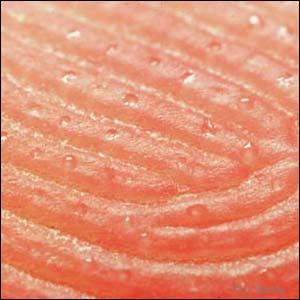
Prints. The skin on the sole of your foot possesses prints. Only the palms of the hands and the soles of the feet possess these tiny undulating folds. The pattern of skin prints on the hands and feet are wholly unique for each person – even genetically-identical twins have unique fingerprints and footprints. Your skin prints are also immutible, meaning they do not change over time. For these reasons fingerprints and footprints can be used for identification. But why do we have these prints on our hands and feet? Answer: To improve grip. The prints on your hands help you to grab and hold objects; the prints on your feet increase traction for walking and running. Like the tread on a car tire, those skin folds augment friction to better enable us to grasp the ground and reduce slipping. Unlike car tires which go ‘bald’ and must be replaced, our skin is self-replenishing, prints and all. Of course, our skin prints are rather useless inside a shoe and many shoe soles are smooth and extrememly slippery by comparison, especially under wet conditions.

Innervation. The soles of your feet are one of the most nerve-rich parts of your body. The three most highly innervated parts of your body are your hands, your face (particulary the lips) and your feet. Why the feet? The feet (when bare) are the only part of your body that is in constant contact with your environment. With over 100,000 nerve endings per foot, tactile feedback from the soles of your feet provide a wealth of information to your brain about the ground upon which you tread. Whether you are walking or running, that information is used to make adjustments (within milliseconds) to your gait, the goal always being to reduce impact forces on your joints and body. Of course, this information is also used to warn you of dangerous terrain or injurous objects. Unfortunately, most footwear creates a ‘shoe-induced neuropathy’ because the thick outersole and cushioned innersole eliminate sensory feedback.

Sweat Glands. The soles of your feet have a tremendous number of sweat glands. In fact, the three ‘sweatiest’ parts of your body are your scalp, your hands and your feet. Although rich in sweat glands, these parts of your body rarely sweat enough to produce dripping sweat; that only occurs under extremely hot conditions or during vigorous exercise. Usually those sweat glands are producing micro-droplets of sweat that quickly evaporate and remove heat from the body. Of course our hands and head are almost always bare and we cover them only under extreme conditions, but our feet are regularly locked away in both shoes and socks. The sweat and heat are thus trapped and the dark, moist, warm, stale conditions inside a shoe become a breeding ground for bacteria and fungi. Shoes are the basic cause of athlete’s foot and the best way to avoid or even cure athlete’s foot is to go barefoot as much as possible. Enclosing the feet in shoes and socks may also lead to difficulty in regulating body temperature, a condition I call ‘hot foot syndrome.’

Attachment. The skin of the sole of the foot is attached to your body exceptionally tightly. The skin on the palms of the hands are similarly attached. You can easily demonstrate this on your hands and feet by pinching the skin. On the top of the foot (and hand) the skin is attached rather loosely to allow flexibility; the skin there can be pinched up and moved about readily. By contrast, the skin of the sole of the foot (and palm of hand) is attached firmly and cannot be easily pinched up or moved side-to-side. This feature increases the skin’s resistance to the high sheer forces experienced when walking and running.

These are just four ways the skin on your foot differs from skin on other parts of your body. There are other differences, too, but these four illustrate the point that the feet are remarkably designed for their functions – standing, walking and running. The skin works best when the foot is bare and kept bare as much as possible. Constantly wearing shoes weakens and softens the skin, making our feet tender and prone to injury. The lack of proper ventilation in closed shoes and socks keeps the skin moist and makes it more vulnerable to invasion by microbes and infection while simultaneously creating the perfect environment for such microorganisms to grow. Going barefoot is healthy for your skin. Callouses and blisters are frequently caused by shoes but rarely result from walking barefoot. With plenty of exposure to sun and air, the skin on your feet will become healthy, strong and beautiful.

Friday, November 5, 2010

Foot Anatomy 101-Windlass Mechanics

In this second installment of the Foot Anatomy 101 series I’d like to discuss what’s known as the windlass mechanism. As discussed in the previous post, the foot arches are the centerpiece of foot function, and the medial longitudinal arch in particular is central to windlass mechanics.

The ‘truss’ of the medial longitudinal arch is formed by the calcaneous (heel bone), the midtarsal joint and the head of the first metatarsal. The plantar aponeurosis forms the ‘tie-rod’ that spans from heel to toes. The attachment of this aponeurosis to the toes beyond the metatarsophalageal (MTP) joints forms the basis of the windlass mechanism.

A windlass is a mechanical device for lifing heavy weights. It usually consists of a spool around which a rope is cranked, the weight being lifted by the rope. A common example is the crank, rope and bucket used to raise water from a well.

In the foot, a windlass is created by the plantar aponeurosis passing beneath the MTP joints, in particular the first MTP joint. When the big toe is dorsiflexed during walking, the aponeurosis winds around the first MTP joint and pulls the heel and toes slightly closer together, raising the medial longitudinal arch and also locking the bones of the foot. It’s an ingenious way of stiffening the foot and converting the supple ‘landing’ foot into a rigid ‘propulsion’ foot.

Unfortunately for shoe-wearing people, none of the above windlass foot mechanics happens in shoes, and this is one reason why shoes are so damaging to feet. Whether you’re wearing a wedge or a sneaker, the foot is immobilized inside the shoe. The toes are kept in a dorsiflexed position by the toe spring (or by virtue of the heel height in a wedge or pumps); the MTP joint does not move at all and windlass mechanics is eliminated. In addition, the constant strain on the plantar aponeurosis likely causes it to weaken (along with associated foot muscles) and this may be a leading cause of shoe-induced flat foot and fallen arches, which is epidemic in shoe-wearing societies.

For proper foot biomechanics… walk barefoot!


Thursday, October 28, 2010

Foot Anatomy 101-The Arches


“The human foot is a masterpiece of engineering and a work of art.” Leonardo da Vinci

The human foot is one of the most masterfully-designed parts of the body. It is often ignored and mistreated, but it is literally the foundation of the body, the base upon which we stand. It is also the only part of the body (when bare) that is in constant contact with our environment. In honor of this humble organ called the foot, I will embark on a series of blog posts on foot form and function. In this first post of the series, I’d like to take a look at the foot arches.

The Human Foot ArchesThe foot arches are the centerpieces of the foot. There are three arches as defined by the skeleton of the foot: the medial longitudinal arch, the lateral longitudinal arch and the transverse arch. Each arch is defined by a curvature of bones secured in position by a “keystone” bone. Many people think of the arches as rigid structures, but they are actually quite flexible and change shape considerably when unrestricted.

When standing and walking the arches are crucial for proper distribution of body weight. As you walk, the bones of the arches guide your weight from your heel along the outer edge of your foot and then across the ball of your foot to the base of your big toe. (From there, your big toe is used to propel you into your next step). During this process the arches “collapse,” especially the medial longitudinal arch. This collapsing is a normal and natural process for shock absorption. Also, the elastic soft-tissue structures of the arch stretch and retain some of the load energy they experience (up to 20%) and then snap back when you lift off, helping to propel you forward.

Of course, none the above really works that well in a shoe, which immobilizes the natural flexing, twisting and stretching movements of the arch.

Arch “supports” are detrimental to foot arches. Consider this: What other part of the body needs support? We don’t wear neck supports for our neck, or arm supports for our arms. For a time, some factory and construction workers wore back supports, but it was quickly discovered that those supports actually weakened the back and increased injuries. The same logic holds true for arch supports. When a supporting structure is placed under the arch it can no longer stretch, flex, collapse or spring the way it’s supposed to. The result is weakened arches… and flat foot. As discussed in The Barefoot Book, several studies have been done now comparing the feet of barefooters to shoe-wearers. Guess what? The shoe-wearing people have 3x higher incidence of fallen arches and flat foot.

I hope you enjoyed this quick summary of your foot arches. Give your arches a break today; kick off your shoes and walk barefoot!

Tuesday, October 26, 2010

The Barefoot Running Book (2e) by Jason Robillard


The second edition of The Barefoot Running Book by Jason Robillard is now available. The greatly expanded seconded edition is sure to be the manual for barefoot running. The first edition, at just 68 pages, seemed a bit rushed, but the 188-page second edition is the complete package. Not only does Jason dive more deeply into the science of barefoot running, he added contributions from numerous experts in the field, including Barefoot Ted McDonald and Barefoot Rick Roeber.

Although Jason touches on the biomechanics and science of running, I think the real strength of his book lies in the practical training plans he provides. From the 5k Cheetah plan to the 26-mile Marathon Hyena plan, he’s got one for every runner. Varied-terrain and debris drills will keep your eye-foot coordination at peak performance while you work your way to barefoot running proficiency. Jason’s diary-style race report of the Hallucination 100 Mile Run seasons the book with a personal touch that will inspire you to keep running.

If you’re at all interested in barefoot running, you owe it to yourself to read The Barefoot Running Book. Jason’s book truly is A Practical Guide to the Art and Science of Barefoot & Minimalist Shoe Running.

Oh yeah, you should also check out Jason's website, Barefoot Running University. I like it, but then I'm a Barefoot Professor!

Wednesday, October 20, 2010

Moving Naturally... MovNat!


I had never heard of Erwan Le Corre until I met him at the 1st Annual NYC Barefoot Run. However, I was fascinated by the man from the moment I met him and my fascination has only increased since I’ve cyber-stalked him in the past two weeks!

Erwan is the founder of MovNat, a revolutionary new way to exercise, move and live in your world. Erwan told me that for healthier bodies adults need to move like children move. After thinking about this, I am absolutely convinced that Erwan is on to something.

Have you ever watched children playing on a playground? They climb ladders, slide down slopes, crawl under and over obstacles, jump from place to place. They are constantly on the move and their motions are anything but repetitve. Contrast this to a typical adult trying to get some exercise; for example, a woman at the gym watching the news while she runs 5 miles on a treadmill. She’s burning calories, but her motions are extremely repetitive. She’s using some muscles over-and-over again while other muscles are hardly working at all. Even the muscles that are working are not working well, using the same motor units and the same muscle fascicles and producing the same amount of tension in the same direction. This is not the best way for our bodies to move. Even when we “change it up” by moving from the treadmill to a cycle machine, we’re primarily using the same muscles and our motions are still repetitive.

Check out this amazing video by Erwan. Yeah, I’m definitely going to incorporate some of this into my exercise “routine.” He's working a book right now... I can't wait for it!

BTW, children instinctively pull off their shoes every chance they get, too. We grown-ups can learn a lot from children!

Monday, October 4, 2010

Welcome to Oz

My favorite theatrical production is WICKED – The untold story of the Witches of Oz. I've seen it three times! (Chicago, San Francisco and Richmond). As you know, in the land of Oz there’s an Emerald City. It’s the one place where Elphaba – the green wicked witch of the West – feels at home (at least for a while).

Now imagine that you live in the Emerald City. In this place everyone dyes their hair green. Parents dye the hair of their newborns as soon as it begins to grow. Children and adults are expected to regularly dye their hair to keep it presentable. You yourself have dyed your hair all your life. Maybe you’re a student at Emerald U., or a professor.

Suppose you discover that the green dye used to color your hair is mildly toxic to your scalp, and you just don’t like the color green for hair. You decide to let your hair grow out in its natural color. As your brown roots begin to show, people take notice. They stare at you. They laugh at you and call you names. Businesses refuse to serve you. Reporters and cameramen from far-off lands follow you around and local newspapers do stories on you. All because you want your own, natural hair color. How messed up is that?

Welcome to Oz.