Thursday, February 3, 2011

I Have A Dream

A few weeks ago we celebrated Martin Luther King, Jr. day. We paused to remember the (peaceful) struggle of American blacks against an oppressive, discriminatory society. We took a day to celebrate a man who dreamed America could be different. I have tremendous respect for MLK, Jr., for his accomplishments and for his daring vision. On MLK day I gathered with my wife and three children around a computer screen to watch his “I have a dream” speech on YouTube. It is with utmost respect for the man and it’s in the spirit of his vision that I modify his words to apply them to my own dream, my own vision of an America free of oppressive discrimination.

You see, I have dream that Americans will one day be free to live barefoot. My dream may seem trivial, but it is not. It is not trivial because at its core it is a struggle against an oppressive attitude toward differences. It is a dream that we will stop shunning those who think outside the box. We say we celebrate such thinking, but we lie. In truth we actively oppress innovative thinking and it’s only through much toil and sweat on the part of such thinkers that real change ever happens among the masses.

I am white. I am educated. Indeed, I am privileged to be among the small portion (less than 1%) of the population with an esteemed doctorate degree – in biochemistry no less, one of those hard sciences that has obtained almost idolistic authority in Western thought. As ‘Dr. Howell, university professor’ I am a respected member of my community. As a barefooter, I have felt the sting of blatant and hateful discrimination: I have been called derogatory names; I have been denied a table at a restaurant; I have been forced off an airplane; I have been escorted by security to the nearest exit. Most ironically, I have been denied a seat on a bus by a black female driver. But I have a dream that one day doing something as healthy – and legal – as going barefoot will be acceptable to my fellow Americans.

I have a dream that little white children and little black children can play together barefoot in the gymnasium. I have a dream that one day employees will be recognized for the quality of their work rather than the price of their wingtips or pumps. I dream of a day when the ‘barefooter’ is applauded for making the more natural and healthier choice to shun her shoes; a choice made not only for the health of her feet but maybe because she also refuses to subvert herself to the role of temptress in high heels in order to be a corporate player.

Truly, I dream of a day when shoes (or the lack thereof) are a non-issue.

They say you can tell a lot about a man by his shoes, but I long for a day when we will be judged by our hard work, our commitment to excellence, our creativity and ingenuity… by the content of our character and not by the shoes on our feet.

Am I insulting Dr. King? Am I trivializing his dream or making a mountain out of a molehill? I don’t think so because ultimately my dream is not about feet, it’s about the end of discrimination in all its forms. It’s about acceptance. It’s about seeing the world a little more like God himself sees it, for we know that “man looks at the outward appearance, but God looks at the heart.” (1 Samuel 16:7).

So yeah, I have a dream. Won’t you join me? Together we can not only free our feet but we can enlarge our hearts to embrace all people despite our differences.

Friday, January 14, 2011

The Difference A Worldview Makes

A largely unknown reality of scientific research is that facts do not speak for themselves. Rather, they are interpreted within a framework called a paradigm, or worldview. Everyone has a worldview, and our worldview flavors the way we interpret information. Our worldview is largely formulated by the culture in which we find ourselves living. Scientists, though trained to be unbiased, are not immune to their culturally-induced worldviews.

For example, in a 2008 study researchers at Auburn University concluded that flip-flops were orthopedically hazardous.* While the research they performed was top-notch, I believe their conclusions were erroneous because their starting assumption – derived from their worldview – was mistaken.

What is their faulty assumption? That walking shod is natural. While they don’t explicitely state this assumption in their reports, it appears evident to me based on their conclusions.

The Auburn team observed that wearing flip-flops causes “sore feet, ankles and legs.” Indeed, this is often true when shoe-wearing people switch to flip-flops in the summer (it’s sometimes called ‘flip-flop-itis’). Auburn researcher Justin Shroyer notes, “We found that when people walk in flip-flops, they alter their gait, which can result in problems and pain from the foot up into the hips and lower back.” Mr. Shroyer is absolutely correct in that wearing flip-flops alters the human gait; what I believe he fails to recognize is that the alteration is a change back to the natural. Constant shoe-wearing had previously altered the subject’s gait to an unnatural one. Switching to flip-flops does cause pain in some people because the walker is returning to a more natural gait – one to which s/he is not accustomed.

Mr. Shroyer and his colleagues also observed that walking in flip-flops led to shorter steps (i.e., shorter stride lengths) compared to wearing athletic shoes. And he found that, in flip-flops, walkers’ heels hit the ground with less vertical impact force and they tend to grip more with their toes during push-off. These findings are consistent with those of other researchers in the field of foot biomechanics; however, the changes were considered abnormal and negative by the Auburn research team. Scientists are now realizing that these barefoot (and flip-flop) induced changes in walking lead to lower impact forces and less stress to leg joints than shod walking (due primarily to shock absorption by the arch and gait adjustments from tactile feedback), and this is generally recognized as a good thing. In addition, the Auburn researchers imply that it’s unnatural to use the toes for push-off and they don’t acknowledge that chronic shoe-wearing is responsible for the shortened tendons and weak muscles that cause the pain flip-flop users feel in the first place. Instead, because they apparently regard the shod gait as natural, they label flip-flops as “bad” and caution folks against wearing them. This is a logical conclusion if you start with the assumption that walking in shoes is natural. If instead you assume that barefoot walking is the natural condition, then the conclusion you draw from their study is very different.

The Auburn study was performed in 2008. In 2011 we now realize that comparing the 'flip-flop' gait to the 'shod' gait is the wrong comparison. Instead, we should be comparing the 'flip-flop' and 'shod' gaits to the 'barefoot' gait. When we do that, we see that walking in flip-flops is more like walking barefoot and is therefore the healthier shoe option.

Different Assumptions = Different Conclusions


Observation

Interpretation #1
(assuming shod gait is natural)

Interpretation #2
(assuming barefoot gait is natural)

1.  wearing flip-flops resulted in pain in feet, ankles, hips and legs

walking in flip-flops causes abnormal & painful changes in gait

walking in flip-flops mimics barefoot walking & reveals unnatural shoe-induced changes in gait

2. wearing flip-flops resulted in shorter stride lengths

long strides should occur (predominantly in front of the body’s center of gravity?)

short strides should occur (predominantly below and behind the body’s center of gravity?)

3. wearing flip-flops resulted in less heel impact forces

gait pattern should be heel-to-toe and heel should take most impact (like in a shoe)

gait pattern should be short leading to landing flatter on arch which absorbs impact forces (as when barefoot)

4. wearing flip-flops resulted in more toe-gripping action

the body should roll on the forefoot into the next step.  (function of the toe appendages?)

the toes grip the ground as the body is pushed into the next step; flip-flops may induce unnatural toe gripping

* http://education.auburn.edu/news/2008/june/flipflop.html

Saturday, January 1, 2011

2011 - The Year of Barefoot Living?

Last year was a banner year for barefooting. Although Christopher McDougall’s Born to Run was released in 2009, I think it had its biggest impact on the world in 2010. This is probably because the book was published in July; people spent the next few months (i.e., the winter 2009) reading the book and then put it into practice in spring 2010. That summer several more related books hit the market: Jason Robilliard’s The Barefoot Running Book and Michael Sandler’s Running Barefoot continued the running-barefoot-is-best theme, but my book, The Barefoot Book, took the concept a step further and demonstrated how shoes are not just harmful when running but also when walking, standing and when just plain wearing them. Like Born to Run, The Barefoot Book was published in the summer. Will the public, after a year of experimenting with barefoot running and a winter to contemplate barefoot living, be ready this summer to take barefooting beyond exercise and into daily life? I believe the answer is YES.

If 2010 was the Year of Barefoot Running, then I believe 2011 will be the Year of Barefoot Living. Maybe I’m just filled with New Year wishful thinking, but I truly believe the tide will turn this year with respect to going barefoot in public. I base this hope on several observations:

1/ The Barefoot Book is generating a lot of conversation. Since the release of the book, I have been interviewed by The Washington Post, Popular Science magazine and dozens of radio shows from New York to New Zealand. I’ve appeared on national and cable television, the Drudge Report and even a documentary in Korea. Clearly, people are interested in the topic of barefoot living and the mainstream media is picking up the conversation. Wow! [Most of these can be found at www.thebarefootbook.com]

2/ Positive comments are on the rise. Every now and then an article appears online about some ‘barefooter’ or living barefoot. In keeping with the popularity of the subject, those articles usually generate a lot of reader comments. In 2010, there appeared to be more articles than ever on the subject and the comments seemed more positive than in the past (I haven’t done a rigorous study on this). My Washington Post article written by Daniel De Vise, for example, generated over 150 comments in just 48 hours. By contrast, the ten following articles written by De Vise obtained no more than 14 comments. The Today Show article about me garnered 128 comments and most of them were positive.

Online articles about barefooting still receive negative comments, but they are the same old comments we’ve seen for years (e.g., broken glass, dog poop, etc.). This time, however, those negative comments are being overwhelmed with intelligent responses debunking the myths. And when the article itself is negative, it gets slammed! The article “Poly students should eliminate barefoot trend” quickly received 26 responses, all which were critical of the article and in favor of barefooting.

3/ Barefoot running precedes barefoot living. In my own experience and that of many barefoot runners I know, barefoot running led to more barefoot living. It’s an obvious and natural next step. Once you experience the thrill of running barefoot you want to experience the thrill of driving barefoot, shopping barefoot and just living barefoot. No one denies that barefoot running went main stream last year. Will all those runners start going to the mall barefoot? No, but some will and all of them will be more open to the idea. And even those who don’t run see others running barefoot and so the idea that bare feet are okay in public is gaining traction.

The days are getting longer (in America) and summer is coming. Let’s make 2011 the Year of Barefoot Living!

Monday, November 29, 2010

INFECTIOUS FEARS

My friend Chanin Nuntavong alerted me to an article written recently by podiatric surgeon Dr. Marybeth Crane. Although the article is titled “Barefoot Passengers in Disgusting Airports,” the article is not about traveling barefoot, it’s about people walking barefoot through security checkpoints, which, by the way, is required at most airports these days.

I’m discovering that the biggest hurdle most people have to going barefoot is the fear of infections. Most people believe there are armies of germs just waiting to attack naked feet and then render the barefooter lame or blind… or dead (Dr. Crane: “You may actually be saving your life with a pair of socks!”). Nothing could be further from the truth.

The fear of getting infections by going barefoot is irrational though understandable given the cultural ‘brainwashing’ we receive throughout childhood – doctors, camp counselors, teachers and parents constantly tell kids that going barefoot is dangerous. It’s an irrational fear however because it’s not based in fact or human experience, and I’m starting to get perturbed at chronically-shod people (like Dr. Crane) infecting the populace with erroneous ideas about barefooting. If you really want to know the hazards of going barefoot, wouldn’t it be best to ask a barefooter?

I recently asked several of my full-time barefooter friends if they’ve ever suffered an infection from going habitually barefoot. The answer was universally “No.” Several of them, in fact, became barefooters to rid themselves of continuing fungal infections (e.g., athlete’s foot or toenail fungus). I stress that these people have been living barefoot for years. I have been barefoot 95% of my life for the past three years, spending as much as 6 months continually barefoot, and like my barefooting friends I’ve suffered no ill-effects from doing so; I’ve in fact benefitted from the experience.

Dr. Crane confesses to believing that airports are disgusting. I can only assume she also thinks fast food restaurants are disgusting, hotels are disgusting, malls are disgusting… heck the whole world must be disgusting. I can’t imagine going through life feeling this way. The irony is that one of the most disgusting places you can put your foot is inside a shoe (if by disgusting she means “germy”). Most people are beginning to realize that shoes are incubators for bacteria and fungi, hence the horrible smell of shoes and the plague of fungal infections in the feet.

Let me address some of the specific threats mentioned by Dr. Crane at disgusting airports:

Plantar warts. This virus infection is caused by walking in wet environments, such as public locker rooms and swimming pools. This is another good example of how most of our shoe behavior is backwards. Normally, we go barefoot in the locker room, then strap on shoes and socks for the rest of the day. As I advise in The Barefoot Book, this is the worst thing we can do. Instead, wear shoes in the public shower and go barefoot the rest of the day. Any fungus you perhaps pick up in the wet environment will likely wear off in the following minutes and hours, saving you from infection. By contrast, putting your foot into a shoe only provides a warm, moist, stale environment for the fungus to grow and infect.

Herpes. I’ve never heard of anyone having herpes on the feet except for congenital cases. I’m not aware of any adult picking up herpes by going barefoot. Can anyone provide case studies or examples?

Fungus. It is well-established that wearing shoes leads to foot fungus, going barefoot eradicates it. See The Barefoot Book for more on this.

Staph. Dr. Crane says that staph bacteria are “growing stronger and infecting more people every day” (are those shod people?) and that MRSA is “more common than ever before.” Again, I don’t know of a single case of someone getting MRSA by going barefoot. Indeed, it is well-known that the best place to get MRSA is in a hospital, the covering of your feet being irrelevant. Outside the hospital, MRSA infection usually occurs via the fingernails and scratching. The unpleasant truth is that people (especially kids) pick their noses and then scratch their itches, like bug bites. The MRSA, which lives harmlessly in the nose, is thereby transferred to the broken skin of the bug bite and infection ensues. This is a good example of why hand-washing and good hygiene are so important.

Finally, Dr. Crane mentions puncture wounds in the article, but she does not mention pseudomonas. Although staph lives harmlessly on the skin all over your body, pseudomonas does not. Pseudomonas thrives in shoes, however, and in one study 50% of shod children with foot puncture wounds obtained a pseudomonas infection; zero barefoot children did (the reference for this study is in The Barefoot Book). Even getting a puncture wound is safer sans shoes. It should also be mentioned that frequently wearing shoes thins and softens your plantar skin, making you more vulnerable to infection. Frequent barefooting toughens and thickens your skin, and keeps it healthy and dry, which combats microbial infection.

Unfortunately, experts like Dr. Crane are still spreading misconceptions about barefooting to the public. In truth, going barefoot is generally safe and is almost always healthier than wearing shoes.

*Dr. Crane's article can be found HERE.

Monday, November 22, 2010

Barefoot Fridays!

Several years ago one of the girl* dorms at Liberty University began a tradition called Barefoot Fridays. Each Friday the girls of that dorm ditch their shoes and spend the entire day barefoot. What a fantastic idea! One that the whole nation should adopt as a new American tradition.

For many of us, shoes are not a daily requirement – not for physical reasons anyway. If you don’t work, safely spending the day barefoot can be just as simple as kicking off your shoes and leaving them off. Even many jobs do not require shoes for safety reasons. If we’re honest, the only reason shoes are “required” is to acquiesce to our cultural ‘shoe rule.’ Whether you work in an office, a classroom or in retail, ask yourself when and why you really need footwear on the job. Could it be possible to actually work barefoot?

If your place of employment is not yet ready to accept full-time barefoot employees, maybe they are willing to adopt Barefoot Fridays. Many businesses already allow a relaxed dress code on Fridays, why not extend that courtesy to our feet? Why not give our feet just one day each week to breathe? Why not one day of the week to give our shoes a vacation and our feet the benefit of a full-day workout? Ask your boss if Barefoot Fridays could be an option at your workplace, and remind him or her that 90% of our foot problems in America can be traced back to the shoe; healthier feet could translate into healthier and more productive employees. If you are the boss, give Barefoot Fridays a try for your employees, at least for a month or two and then re-evaluate the policy.

We’ve all heard the oracle: “Everything in moderation.” When it comes to footwear, however, we are far from moderate. With just a few exceptions we wear shoes all day, every day, everywhere we go and for everything we do. Adopting Barefoot Fridays could be a great way to give our feet some sensible barefoot time.

This Friday, go barefoot! When others ask you about it just say, “Haven’t you heard? It’s Barefoot Friday!”

*Liberty University has separate male and female dorms.

Monday, November 8, 2010

Foot Anatomy 101-The Special Skin on Your Feet

In this third post in the Foot Anatomy 101 series I’d like to discuss the unique “feetures” of the skin on your feet. Since so much about the feet are are unlike other parts of the body, it will probably not surprise you at this point to learn that the skin on your feet is also unique, being especially adapted to the demands of walking and running. Here are some of the special features of ‘foot skin’:

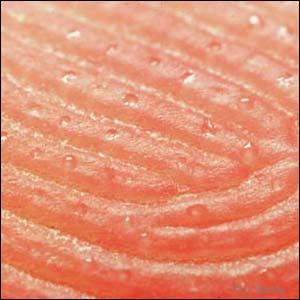
Prints. The skin on the sole of your foot possesses prints. Only the palms of the hands and the soles of the feet possess these tiny undulating folds. The pattern of skin prints on the hands and feet are wholly unique for each person – even genetically-identical twins have unique fingerprints and footprints. Your skin prints are also immutible, meaning they do not change over time. For these reasons fingerprints and footprints can be used for identification. But why do we have these prints on our hands and feet? Answer: To improve grip. The prints on your hands help you to grab and hold objects; the prints on your feet increase traction for walking and running. Like the tread on a car tire, those skin folds augment friction to better enable us to grasp the ground and reduce slipping. Unlike car tires which go ‘bald’ and must be replaced, our skin is self-replenishing, prints and all. Of course, our skin prints are rather useless inside a shoe and many shoe soles are smooth and extrememly slippery by comparison, especially under wet conditions.

Innervation. The soles of your feet are one of the most nerve-rich parts of your body. The three most highly innervated parts of your body are your hands, your face (particulary the lips) and your feet. Why the feet? The feet (when bare) are the only part of your body that is in constant contact with your environment. With over 100,000 nerve endings per foot, tactile feedback from the soles of your feet provide a wealth of information to your brain about the ground upon which you tread. Whether you are walking or running, that information is used to make adjustments (within milliseconds) to your gait, the goal always being to reduce impact forces on your joints and body. Of course, this information is also used to warn you of dangerous terrain or injurous objects. Unfortunately, most footwear creates a ‘shoe-induced neuropathy’ because the thick outersole and cushioned innersole eliminate sensory feedback.

Sweat Glands. The soles of your feet have a tremendous number of sweat glands. In fact, the three ‘sweatiest’ parts of your body are your scalp, your hands and your feet. Although rich in sweat glands, these parts of your body rarely sweat enough to produce dripping sweat; that only occurs under extremely hot conditions or during vigorous exercise. Usually those sweat glands are producing micro-droplets of sweat that quickly evaporate and remove heat from the body. Of course our hands and head are almost always bare and we cover them only under extreme conditions, but our feet are regularly locked away in both shoes and socks. The sweat and heat are thus trapped and the dark, moist, warm, stale conditions inside a shoe become a breeding ground for bacteria and fungi. Shoes are the basic cause of athlete’s foot and the best way to avoid or even cure athlete’s foot is to go barefoot as much as possible. Enclosing the feet in shoes and socks may also lead to difficulty in regulating body temperature, a condition I call ‘hot foot syndrome.’

Attachment. The skin of the sole of the foot is attached to your body exceptionally tightly. The skin on the palms of the hands are similarly attached. You can easily demonstrate this on your hands and feet by pinching the skin. On the top of the foot (and hand) the skin is attached rather loosely to allow flexibility; the skin there can be pinched up and moved about readily. By contrast, the skin of the sole of the foot (and palm of hand) is attached firmly and cannot be easily pinched up or moved side-to-side. This feature increases the skin’s resistance to the high sheer forces experienced when walking and running.

These are just four ways the skin on your foot differs from skin on other parts of your body. There are other differences, too, but these four illustrate the point that the feet are remarkably designed for their functions – standing, walking and running. The skin works best when the foot is bare and kept bare as much as possible. Constantly wearing shoes weakens and softens the skin, making our feet tender and prone to injury. The lack of proper ventilation in closed shoes and socks keeps the skin moist and makes it more vulnerable to invasion by microbes and infection while simultaneously creating the perfect environment for such microorganisms to grow. Going barefoot is healthy for your skin. Callouses and blisters are frequently caused by shoes but rarely result from walking barefoot. With plenty of exposure to sun and air, the skin on your feet will become healthy, strong and beautiful.

Friday, November 5, 2010

Foot Anatomy 101-Windlass Mechanics

In this second installment of the Foot Anatomy 101 series I’d like to discuss what’s known as the windlass mechanism. As discussed in the previous post, the foot arches are the centerpiece of foot function, and the medial longitudinal arch in particular is central to windlass mechanics.

The ‘truss’ of the medial longitudinal arch is formed by the calcaneous (heel bone), the midtarsal joint and the head of the first metatarsal. The plantar aponeurosis forms the ‘tie-rod’ that spans from heel to toes. The attachment of this aponeurosis to the toes beyond the metatarsophalageal (MTP) joints forms the basis of the windlass mechanism.

A windlass is a mechanical device for lifing heavy weights. It usually consists of a spool around which a rope is cranked, the weight being lifted by the rope. A common example is the crank, rope and bucket used to raise water from a well.

In the foot, a windlass is created by the plantar aponeurosis passing beneath the MTP joints, in particular the first MTP joint. When the big toe is dorsiflexed during walking, the aponeurosis winds around the first MTP joint and pulls the heel and toes slightly closer together, raising the medial longitudinal arch and also locking the bones of the foot. It’s an ingenious way of stiffening the foot and converting the supple ‘landing’ foot into a rigid ‘propulsion’ foot.

Unfortunately for shoe-wearing people, none of the above windlass foot mechanics happens in shoes, and this is one reason why shoes are so damaging to feet. Whether you’re wearing a wedge or a sneaker, the foot is immobilized inside the shoe. The toes are kept in a dorsiflexed position by the toe spring (or by virtue of the heel height in a wedge or pumps); the MTP joint does not move at all and windlass mechanics is eliminated. In addition, the constant strain on the plantar aponeurosis likely causes it to weaken (along with associated foot muscles) and this may be a leading cause of shoe-induced flat foot and fallen arches, which is epidemic in shoe-wearing societies.

For proper foot biomechanics… walk barefoot!