Wednesday, April 6, 2011

I Need Your Help!

Kids do not have to wear shoes to school in Aukland.

I’ve never done this before, but I’m asking my shoe-wearing friends to help me out. If you are not a barefooter, if you have no desire to become one, then we barefooters could really use your help.

I ran into a friend recently who got kicked out of two stores in as many days (for being barefoot, of course). She went through the usual routine that has become a habit for us barefooters: she asked why, she was told the myths (health code, liability, etc.) and she debunked them, then she was ejected from the building anyway. After going through similar situations myself for the past five years it has become abundantly clear that having the facts [1] on your side is irrelevant (that is an especially hard pill to swallow for the one who literally wrote the book).

My friend’s recent confrontations illustrate the discrimination that barefooters face: if I go barefoot into a business today I run a significant risk of being bullied and thrown out. Seriously, if you are not a barefooter you likely do not understand the level of vitriol I’m talking about – I’ve been called an idiot and disgusting by managers; I’ve had security called on me to escort me to the nearest exit; I’ve been asked to leave an airplane sitting on the tarmac! In short, I have literally been treated like a criminal for not wearing shoes.

If you think this is wrong, then help us.

Sadly, I believe businesses will continue to discriminate against barefooters until/unless enough people go barefoot that they are forced to stop. Kroger cannot kick out 10% of their customers! To do so would impact their bottom line and even they would see that kicking out that many people is rude on their part. So what can you do to help us?

Go barefoot.

Now you don’t have to go barefoot all the time, just please consider going barefoot in public occasionally. Every now and then just slip off your flip flops and go into that store barefoot. If you don’t get hassled, then no harm came of it. Indeed, it will be beneficial because it will demonstrate to others that going barefoot in public is okay. If you do get hassled, then just put on your shoes and go about your business. Preferably, you can explain to the shoe police [2] that you are not a barefooter but you are sympathetic to their right to go barefoot and that’s why you did it. Who knows, the managers and policy makers may actually respect and listen to you; they certainly are not respecting and listening to us.

So there you have it. Please consider helping us barefooters by simply kicking off your shoes when you run your next errand. By doing so, you may play a significant role in helping to end discrimination against us. And hopefully, you will enjoy the experience!

*****
[1] For example, it is factually correct that there are no health codes that prohibit bare feet in a grocery store in Lynchburg, VA; it is also factually correct that going barefoot is healthier and safer than balancing on the 3-inch heels the store manager is wearing.
[2] Shoe police = that employee that forces you to put on your shoes.

Friday, April 1, 2011

Foot Anatomy 101-Biofeedback


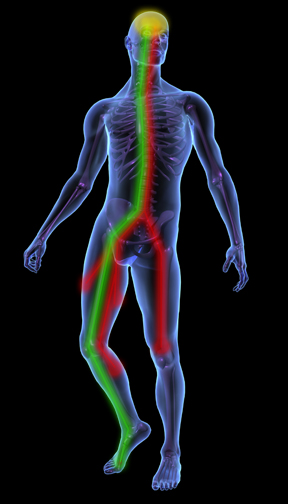
Continuing our Foot Anatomy 101 series, I’d like to discuss the role of natural biofeedback to the proper mechanics of walking and running. Natural biofeedback [1] is the gathering of information from body receptors in order to monitor and fine-tune body functions. The brain relies on sensory receptors to gather that information.

There are three types of receptors in the human body: exteroceptors, interoceptors and proprioceptors. Exteroceptors gather information from the outside world; interoceptors gather information from internal organs and proprioceptors keep track of body position. When the brain issues a command to move it receives biofeedback from receptors to ensure that the movement is going as planned. When walking, much of that biofeedback comes from exteroceptors in the soles of the feet. Biofeedback has been underappreciated by podiatrists and foot specialists for decades, but scientists (and runners) are beginning to gain a deeper understanding of its role in human ambulation.

With an estimated 100,000 - 200,000 exteroceptors in the sole of each foot, your feet are among the most nerve-rich parts of your body. This fact alone should demonstrate the importance of touch to walking and the benefit of going bare for walking properly. But why are there so many nerve endings in the feet? How do those sensitive soles aid walking?

Stand up and walk around (barefoot). When standing and walking, the sole of your foot is the sole part of your body in touch with the environment [2]. Sensory information from the foot is used to protect the foot itself from injury, but it’s also used by the brain to make subtle adjustments in your gait to protect bones and joints all the way up your body and to maximize the efficiency of your movements. In others words, it makes walking more fluid and graceful and safe. It takes only milliseconds for sensory information from your foot to reach your brain and for your brain to respond by making adjustments to muscles in your legs, back and arms. By contrast, walking in shoes is far more clumsy and inefficient due (in part) to impaired biofeedback. Muscle contractions, impact forces and joint range-of-motion are measurably different when barefoot [3-8].

Shoe-Induced Neuropathy
A typical walking shoe possesses a hard rubber outer sole and a soft cushioned insole. In addition, people generally wear socks with shoes. These materials lift your feet an inch or more from the ground and silence the biofeedback from exteroceptors. In shoes, the brain receives almost no useful information from the soles of the feet. This lack of sensory feedback is called neuropathy and is considered pathological and dangerous under any other circumstance than shoe-wearing. Because foot biofeedback has been unappreciated for so long, shoe-induced neuropathy has also been ignored by doctors for decades.

Walk Barefoot? On Gravel?
Most people have extremely tender feet after years of wearing shoes. This tenderness is partly due to the soft and thin skin which has developed from lack of use, but the perception of pain takes place in the brain not the body. Most of us have been told to wear shoes since early childhood; consequently, our brains are unaccustomed to receiving tactile information from the feet.  On those rare occasions when we do walk barefoot, our brains receive ‘sensory overload’ and interpret the strange sensations as painful. Deaf persons who receive their hearing through cochlear implants report their first sounds as painful for the same reason. However, once the brain figures out that the new stimulus is not harmful, the pain subsides. Indeed, what was once considered painful is now re-interpreted as pleasure.

Yes, you can walk and run barefoot on gravel and many other rough surfaces. Gravel poses no threat to your feet, and once your brain discovers this (which can take more than an act of will but time and experience) you can walk on it just fine. And the biofeedback you receive will ensure that your feet and joints are working optimally in addition to providing you with new vistas of pleasure.

Of course, you also need to toughen those tender soles!
**********


Footnotes/References:
1. Artificial biofeedback is an attempt to willfully regulate involuntary body functions being externally monitored.
2. The two other nerve-rich body parts – your hands and mouth – are also parts that frequently contact the environment. The use of touch by your hands is obvious, but your mouth must also use touch to monitor what enters your body. Your mouth is sensitive enough to detect an unwanted stray hair in your bite of cheeseburger.
3. Cunningham et al. (2010). The influence of foot posture on the cost of transport in humans. Journal of Experimental Biology 213:790.
4. De Wit et al. (2000). Biomechanical analysis of the stance phase during barefoot and shod running. Journal of Biomechanics 33:269.
5. Wolf et al. (2008). Foot motion in children shoes – a comparison of barefoot walking with shod walking in conventional and flexible shoes. Gait & Posture 27:51.
6. Stacoff et al. (2000). Tibiocalcaneal kinematics of barefoot versus shod running. Journal of Biomechanics 33:1387.
7. Seth (1977). The foot and footwear. Prosthetics and Orthotics International 1:173.
8. Lieberman et al. (2010). Foot strike patterns and collision forces in habitually barefoot versus shod runners. Nature 463:531.

Thursday, March 31, 2011

Two Gospels


I had the opportunity to speak at my church the other day. How did a barefoot professor get invited to speak at church on a Sunday morning?

My church (Blue Ridge Community Church) is rather large – we hold three services on Sunday morning and greet 2,500 people each week.  At BRCC, we often teach on themes, or series, that span several weeks or months.  We started a new series recently called The Body which examines the analogy God makes in Scripture that his people – the church – constitute his body (Jesus being the head). To kick off the series they wanted an expert on the human body to come “Wow!” people on the wonders of the human body machine. For some reason they chose me. J So I gave a 20-minute crash course on how the ear achieves hearing with some flashy 3D animation and I guess they liked it because they’ve asked me to come back and speak again.

So why is this on the barefoot professor’s blog? Does this have anything to do with foot health or the barefooting movement? Of course; here it is.

I always go to church barefoot. Always. The regular attendees at BRCC know me well and they accept me barefoot.* However, our church is a seeker church; with concert-style worship (including a smoke machine) and preachers in blue jeans, we are good at drawing in unbelievers and then getting them hooked (or “saved”). Indeed, we have well over 100 people baptized every year at BRCC! So, on any given Sunday we will have a mixture of regulars and newbies in attendance.

Despite the casual atmosphere at BRCC, the church officially bans bare feet on the stage; speakers, singers and musicians must wear at least flip flops. In observance of this rule I wore a pair of flip flops to give my dashing talk on the human ear, but then an interesting thing happened. After the first service many people commented on my shoes and felt it was too unusual for me. In fact, so many people commented that I was told I could teach barefoot for the second and third services. Wow! That is a major departure from the norm and I was truly “feeling the love” from both the congregation and the leaders of Blue Ridge.

 But I wore my flip flops on stage for both remaining services. Why?

Gospel = good news.

The word gospel means good news. I have two gospels in my life; I call them my ‘greater gospel’ and my ‘lesser gospel’. The lesser gospel is that you can live barefoot and that living barefoot is more natural and healthier than living with shoes. My greater gospel is that Jesus is the Messiah, the hero who came in and saved the day, the one who reconciles evil humanity to a Holy God.

So why did I wear shoes on stage when I was told I could teach barefoot? Because nothing trumps the greater the gospel, not even the lesser gospel of barefooting. The apostle Paul encouraged us to become all things to all people so that we might win some to Christ. The fact is that I live in a shoe-wearing society and being barefoot on stage might be a distraction to some people; I will not let my love for my lesser gospel deter people from the greater gospel.

Now for a point of clarification: I DID take off my shoes in both the second and third services and teach barefoot, but only after I took the stage and started teaching shod. I gave the newbies in the audience a few minutes to get to know me before I casually slipped off the flip flops in the middle of my talk. In this way, I hope I gave them a taste of both my gospels!
**********
 
* In fact, bare feet are perfectly okay at BRCC; dozens of people can be seen barefoot there on Sunday mornings in the summer.

Wednesday, March 2, 2011

Stepping on Nails

Feet from the Barefoot Hikers of VA
A wonderful article on barefoot living entitled Living Without Shoes appeared on ABCNews.com today. Overall, I thought the writer (Meg Wagner) did a fantastic job of finding the right people to interview (myself excluded) and presenting an accurate picture of why many of us choose to go barefoot. Reporters, however, seem to have a genetic need to balance every position with a counter-position (I'm not neccessarily opposed to that) and so Wagner interviewed a podiatrist to give the standard barefoot-is-dangerous warning from the medical community. Unfortunately, the podiatrist Wagner interviewed didn't even provide scientifically sound reasons for keeping your shoes on.

Podiatrist Dennis Frisch says that he is not anti-barefoot and that barefooting has its place, but "outside isn't that place." He says that "a blister or corn caused by wearing an uncomfortable shoe will take a couple of days to heal on its own. But a cut caused by stepping on undesirable material while barefoot could potentially become infected and be a severe medical problem."

Okay, here is where I have my problem.

Any cut has the potential to become infected and be a severe medical situation, but which is better... cutting a shod foot or a bare one? Is it better to step on a nail barefoot or wearing a sneaker?

A number of scientific studies have been published on the subject (references below). In all of them the conclusion is definitive: shoes increase the risk of infection, particularly infection by pseudomonas bacteria.

Pseudomonas does not live on human skin, but it thrives in shoes (indeed, pseudomonas is the cause of that notorious stench). It's thus not surprising that in one study it was found that roughly 50% of children wearing shoes acquired a pseudomonas infection but zero barefoot children did. It should be noted that a pseudomonas infection can be seriously dangerous, even fatal, especially when delivered deep into the body in a hard-to-clean puncture wound. In addition, I've had more than one doctor tell me that it's not uncommon for a millimeter-sized piece of shoe sole to get embedded in a puncture wound when wearing shoes. Having a foreign object buried a half-inch into your body is rarely a good thing.

So, based on the scientific evidence, Dr. Frisch should be warning us that 'stepping on undesirable material [while shod] could potentially become infected and be a severe medical problem.'

Oh, well.

References:
1.Fisher MC, Goldsmith kJF, Gilligan PH. Sneakers as a source of pseudomonas aeruginosa in children with osteomyelitis following puncture wounds. J Pediatr 1985; 106: 607-09.
2.Green NE, Bruno j. Pseudomonas infection of the foot after puncture wounds. South Med J 1980; 73( 146-49).
3.Jacobs RF, McCarthy RE, Elser JM. Pseudomonas osteochondritis complication puncture wounds of the foot in children. A 10 year evaluation. J Infect Dis 1989; 160: 657-61.
4.Jarvis JG, Skipper J. Psedomonas osteochondritis complicating puncture wounds in children. J Pediatr Orthop 1994; 14: 755-9.
5.Johanson PH. Pseudomonas infections of the foot following puncture wounds. JAMA 1968; 204: 170-72.
6.Laughlin TJ, Armstrong DG, Caporusso J, Lavery LA. Soft tissue and bone infections from puncture wounds in children. Western Journal of Medicine 1997; 166( 2): 126-8.
7.Niall DM, Murphy PG, Fogarty EE, Dowling FE, Moore DP. Puncture wound related pseudomonas infections of the foot in children. Irish Journal of Medical Science 1997; 166( 2): 98-101.
8.Verdile VP, Freed H, Gerard J. Puncture wounds to the foot. J Emerg Med 1989; 7: 193-99.

Thursday, February 24, 2011

A Letter From Belgium

Dear Dr. Howell,

As soon as I heard about your book I decided it was a Must to read and tried to obtain it. Living in Belgium it took me nearly four months to acquire it through Amazon. It was worth every second of the wait. As soon as I got it I read it through a first time in four hours. WONDERFUL !!!

I find it amazing and a great quality that a scientist is able to get all the scientific information across in simple words that everybody can understand.

The BFB explains so well and in such detail how the human foot functions or is supposed to, and how shoes interfere with the functioning of nature’s creation.

It was, and still is, great to read what shoes are doing to you, from just a benign blister, ouch, to deformities that may require surgery. I never gave a thought to the quantity of chemicals that go into the production of shoes and remain there.

Thank you for debunking the myths, although laws and regulations here in Europe may be different from those in the US, I don’t believe that there are any laws over here that make walking or driving barefoot illegal, but as in the US it’s a widespread belief.

I have been barefoot myself for the last 38 years, that is for about 95% of the time and I still find it a wonderful way of living, walking, hiking. I have been working as a nature guide for the last couple of years and work barefoot for most of the time. This usually raises eyebrows and provokes comments and questions to which I respond to the best of my knowledge. I’m sure that your book will be most helpful in the future to be able to better explain the “why” question.

The only negative comment I could mention about your wonderful book is that it’s pretty hard to obtain it on the old continent. None of the major bookstores could obtain it.

Thank you for your kind comments, dear reader in Belgium! I'm glad it was worth the wait.

[Note: The Barefoot Book is now available for nook and soon for the kindle and other electronic devices. That should make global access much easier!]

Wednesday, February 16, 2011

Skechers Gets Sued

UPDATE: Skechers is getting into more legal trouble as even more people are getting injured by these shoes. Read about it here.

Skechers, the maker of Shape-Ups toning shoes, is being sued by a woman who claims the shoes severely injured her body. Holly Ward wore the shoes at work and during her leisure time for five months before developing severe pain in her hips. It turns out she obtained stress fractures in both of her femur bones. The femur, incidentally, is the largest and heaviest bone in the body; fracturing that bone is no small feat.

I warn of the dangers of these types of shoes in The Barefoot Book.

Skechers Shape-Ups are modeled after the MBT shoe. Both shoes possess a rounded sole that purportedly offers a workout just by wearing them. Scientific studies have shown that MBT shoes work muscles differently, but there’s no evidence that these shoes ‘tone’ your body, especially the buttocks which are undoubtedly the focus of consumers. However, it is obvious (or at least should be obvious) to anyone who knows anything about the biomechanics of human ambulation that these shoes are dangerous. Not only are MBT and Skechers unstable to the point of risking falls, they alter the human gait so dramatically that injuries are bound to happen. Just ask Holly Ward.

How do toning shoes alter the human gait? They convert the natural stepping motion into a rolling motion. Unfortunately, this is not really unique to toning shoes; virtually all shoes make this conversion, but toning shoes take the ‘rolling step’ to the extreme.

I hope this lawsuit will educate more people to the hazards of toning shoes. Perhaps this will move us one step closer to having warning labels put on shoes that dramatically alter gait.

Now, if only one of those 20,000 women per year put the hospital by high heels would sue their shoe-maker!

Saturday, February 12, 2011

The Answer To The Question.

I recently received a question from a woman who wants to go barefoot more often but finds it painful. Rather than responding directly to her I want to respond publicly because I think her real issue is not with her feet but with our culture. Consequently, it’s an issue all of us who want healthy, shoeless feet must deal with. Before I respond, let me share with you her comment in its entirety:

“I have very pronate feet, fairly wide hips, and an abnormally large Q angle. When I have gone almost an entire day barefoot, my back, hips, knees and feet are aching and painful for the next day after - there have been nights where I have had trouble falling asleep because of how much discomfort going barefoot inflicted on my body. In other words, for me going barefoot HURTS! I've worn orthotic inserts since I was about ten years old and this has affected the types of shoes I've worn: I have to find wide shoes that accommodate my inserts, I can't wear dress shoes with heels, and I can't wear sandals. Would going barefoot more often help someone like me, in your opinion? Because all it's ever brought me is more pain and discomfort.” – Kaje

Let me start by focusing on the phrase “When I have gone almost an entire day barefoot…”

Walking barefoot is natural; walking in shoes is unnatural. Shoes demonstrably (and negatively) change the way we stand, walk and run and thus create a host of foot problems, not the least of which is muscle atrophy and skeletal deformation since the shoe is essentially a binding cast. Shoes affect more than the feet: the elevated heel found in virtually every shoe demands postural adjustments all the way up the body and the narrow toe box, toe spring, arch support and elevated heel conspire to encourage over-pronation, which also affects your ankles, knees and hips. In addition to shoes, this dear woman has worn orthotics since she was ten years old, but… she has never spent a full day barefoot. What Kaje is saying it similar to: "When I take the cast off my arm for almost an entire day my elbows and shoulders hurt." Unfortunately, this situation describes most of us in ‘civilized’ society and there is no hope that we can ever have strong, healthy feet if that’s the case.

The daily wearing of shoes has wrecked our feet. If you’ve worn orthotics your feet are doubly-wrecked. Our feet have literally been debilitated by footwear and healing can only come by removing the shoes and rehabilitating our feet by miles and miles and miles of barefoot walking and running. For better or for worse, the brutal truth is that the damage done by thousands of hours of shoe wearing cannot be undone by going barefoot a few hours here-and-there on nights and weekends.

Kaje, you say your feet hurt if you spend too many hours barefoot. I predict the pain would subside if you could stay out of shoes for an entire month or two, but can you do that? If you could, your feet would become rehabilitated and stronger and healthier than ever. Will your circumstances permit you to remain barefoot for weeks or months at a time? Will your feet hurt during the rehab process? Probably yes. The soreness you presently feel from going barefoot stems from the fact that you are using muscles in ways you don't use them in shoes; it's similar to the soreness you would feel after a day of skiing. However, if you could commit to spending just several months barefoot [1], your feet will strengthen, your gait will correct itself and your entire body will benefit. (Indeed, with rehabilitated feet and gait your wide hips and Q-angle will probably not be an issue). At the end of the rehab process, putting on shoes will feel so obviously unnatural and awkward you will likely not do it. Welcome to full-time barefooting.

And this is why we as a society must allow bare feet back into the public square. There is a growing number of people who are fed up with the ill-effects of shoes on their bodies and they want to exercise the healthier option of living without shoes as much as possible. Consequently, our culture must adjust. I think our culture will adjust because the barefooting ‘movement’ is growing rapidly and once you’ve experienced the benefits of going shoeless there is no going back! Personally, I’m at a place where I snub the social pressure and refuse to let anyone make me put on shoes [2]. More and more people are adopting this attitude.

Finally, I want to add that it’s high-time podiatrists took the blame for our wrecked feet. Society has told us to wear shoes, but podiatrists have done nothing to oppose this and have in fact endorsed shoe wearing and – even worse – carelessly promoted orthotics. It’s time for podiatrists to apologize [3] to Kaje and inform the public of the many negative consequences of wearing shoes and endorse and promote barefoot living for healthier feet.

So Kaje, the answer to your question – as always – is to ditch the shoes. I hope you can keep them off long enough to rehabilitate your feet and reap the benefits. Let me know how it goes!

--------
1. I say “just” several months barefoot because, after all, you’ve spent years in shoes.
2. The only exception being my boss because – other than the shoe rule – I really love my job. If I didn’t love Liberty University, believe me I would ditch the job and move; there are hundreds of colleges out there that would let me teach barefoot.
3. There is a place for orthotics and maybe Kaje genuinely needs them, but orthotics should always be the exception, not the rule.